logo-color.jpg)
Selection Year: FY2022
Project Title: Commercializing an Acoustic Emission–Based Crop Cultivation Solution for Monitoring Plant Water Dynamics
Principal Investigator: Saitama University, Kensuke Kageyama
- Background of Research and Commercialization
Detecting sounds emitted by microscopic bubbles within plant tissues
-
- Plants draw water from their roots up to their leaves. During this internal water transport, tiny bubbles are generated within plant tissues, producing acoustic emissions (AE). We have been conducting research on sensors capable of detecting these microscopic AEs, and by utilizing a charged material known as an electret, we have developed a low-cost sensor that can detect plant-generated AEs.
Because the developed sensor can finely capture minute AEs simply by making contact, we believe it has the potential to become a novel biological AE sensing technology. As an initial application, we considered commercializing the technology as a method for diagnosing plant water status in crop cultivation where irrigation management is critical, such as tomato production. Furthermore, since this sensor excels at detecting acoustic signals transmitted through soft materials such as living organisms and water, we have begun to explore its potential for sensing AEs emitted by a wide variety of biological entities that have not previously received much attention.
- Plants draw water from their roots up to their leaves. During this internal water transport, tiny bubbles are generated within plant tissues, producing acoustic emissions (AE). We have been conducting research on sensors capable of detecting these microscopic AEs, and by utilizing a charged material known as an electret, we have developed a low-cost sensor that can detect plant-generated AEs.
- Project Overview
Real-Time Monitoring of Crop Water Status
-
- We have developed a low-cost sensor that can be easily attached to the stems of crops such as tomatoes and cucumbers in cultivation facilities including greenhouses, enabling real-time visualization of acoustic emissions (AE) generated by these crops. Through AE sensing of these crops, it has become clear that the AE data are closely related to crop growth conditions, particularly water status.
In addition, we are working to establish a business model by integrating this technology with the automated irrigation and fertilization service “Zero Agri” provided by Rootrek Networks. By monitoring plant water status using AE data, we are developing technologies that support crop cultivation and are currently conducting demonstration trials. Furthermore, the sensor can now be attached to fruit trees such as mandarin oranges to detect AE, and we are advancing the technology for application in fruit tree cultivation as well.
- We have developed a low-cost sensor that can be easily attached to the stems of crops such as tomatoes and cucumbers in cultivation facilities including greenhouses, enabling real-time visualization of acoustic emissions (AE) generated by these crops. Through AE sensing of these crops, it has become clear that the AE data are closely related to crop growth conditions, particularly water status.
- Future Outlook
From Experimental Use to a Cultivation Support Solution
-
- As a new sensing technology capable of providing real-time information on plant water status, we will launch a business focused on experimental and research applications that enables the acquisition of plant water data that has not been accessible until now. We then aim to further develop this technology into a cultivation support solution tailored to crops such as tomatoes and cucumbers, where precise irrigation control is essential.
Furthermore, because the developed sensor covers an exceptionally wide frequency range from 1 Hz to 300 kHz, it has the potential to detect acoustic emissions (AE) generated by a wide variety of biological organisms. Accordingly, we are currently exploring AE sensing in organisms such as algae and honeybees, and we aim to identify promising biological cultivation fields beyond crop production where AE sensing can be commercialized.
- As a new sensing technology capable of providing real-time information on plant water status, we will launch a business focused on experimental and research applications that enables the acquisition of plant water data that has not been accessible until now. We then aim to further develop this technology into a cultivation support solution tailored to crops such as tomatoes and cucumbers, where precise irrigation control is essential.
- Message
- We named our newly developed sensor the “Touch Acoustic Sensor” because it can detect delicate sounds and vibrations simply by touching a target. Using touch acoustic technology, we will promote the commercialization of systems that support cultivation by capturing subtle plant movements.
Looking ahead, our vision extends beyond agriculture. We aim to create a society that connects people with diverse ecosystems by sensing the sounds of life in many different fields. Why not join us in the challenge of capturing and applying the sounds emitted by a wide variety of living organisms? - If you are a business or research institution interested in learning more about or trying the Touch Acoustic Sensor, please contact us via the inquiry form or through the contact details listed on the Team page (Saitama University).
- We named our newly developed sensor the “Touch Acoustic Sensor” because it can detect delicate sounds and vibrations simply by touching a target. Using touch acoustic technology, we will promote the commercialization of systems that support cultivation by capturing subtle plant movements.
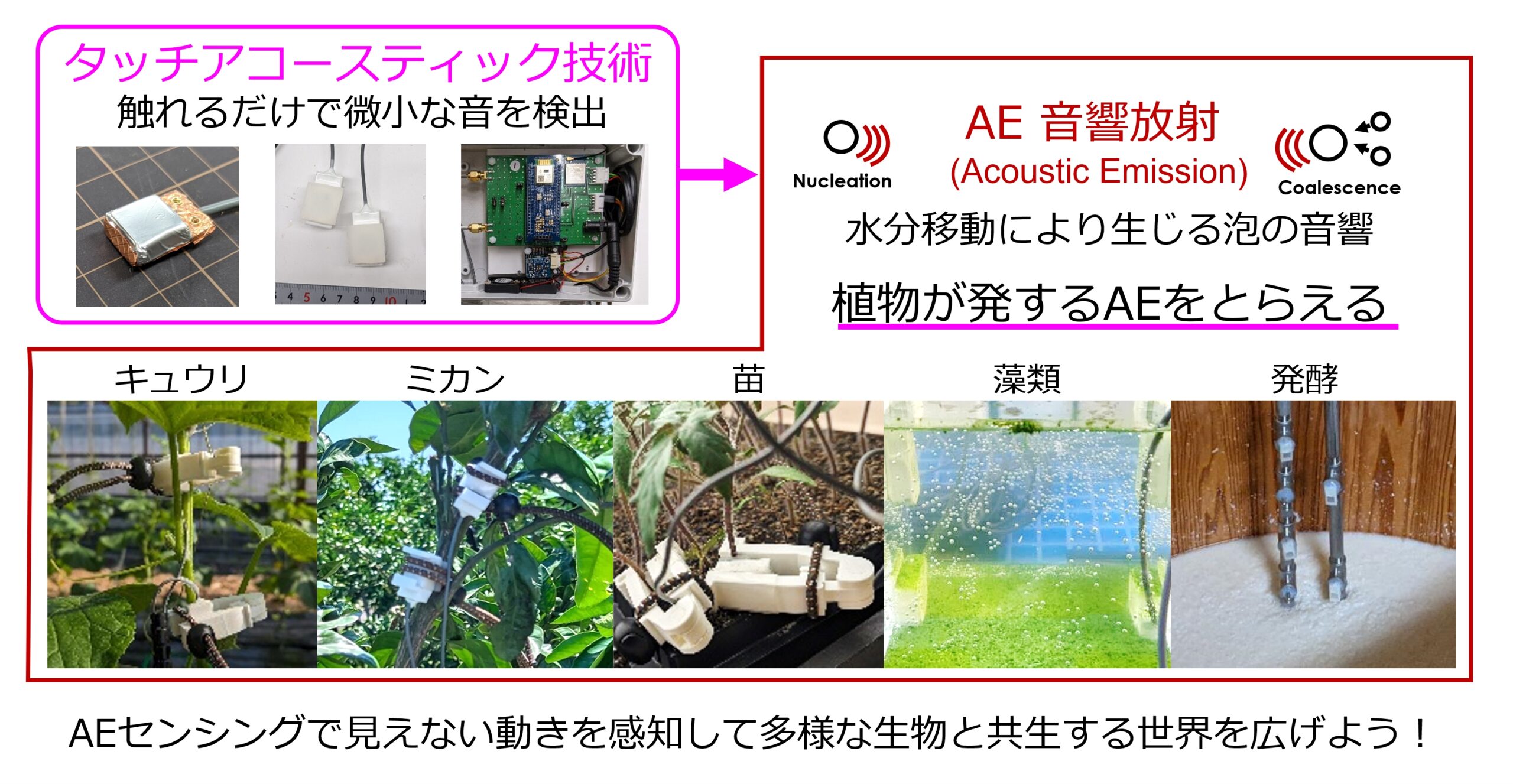
About the Touch Acoustic Sensor